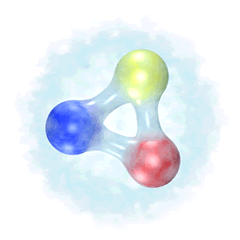
 In deep-inelastic scattering, one of the main processes employed in the study of the nucleon structure, high momentum electrons hit hard the quarks inside the nucleon.
The way the electrons are scattered off depends on the distribution of the quarks in the nucleon. During the last forty years, tremendous progress in the technology employed in deep-inelastic scattering experiments, and in the development of the theoretical interpretation of the experimental results has been achieved.
Nowadays, we know quite accurately how the total momentum is shared among the partons (quarks and gluons) in a nucleon, i.e. we have a pretty clear mono-dimensional picture of the nucleon in momentum space.
Recently, the study of semi-inclusive deep-inelastic scattering opened the way to a multi-dimensional picture of the nucleon, thus offering new perspectives to our understanding of QCD.
Thanks to these studies, it is now clear that partons do not move all in the same direction in an orderly manner, but they can also wander around in directions transverse to the nucleon's path. In a concrete experiment it is not possible to directly observe how the partons are moving inside the nucleon. Rather, we see the effect of the primordial partonic motion through the distribution of the debris after a deep-inelastic collision.
In addition, there can be correlations of all kinds between the spin of the nucleon and the spin and momentum of partons.
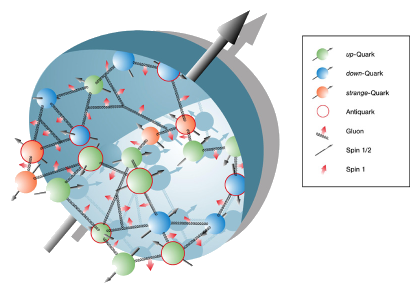 Each kind of correlation, described by a peculiar parton distribution functions (PDF), can teach us something new about the way partons are organized inside the nucleon and can help us estimating how large is the contribution of partonic angular momentum to the spin of the nucleon.
In recent years, Transverse Momentum Dependent (TMD) PDF are increasingly gaining theoretical and
experimental interest.
Each kind of correlation, described by a peculiar parton distribution functions (PDF), can teach us something new about the way partons are organized inside the nucleon and can help us estimating how large is the contribution of partonic angular momentum to the spin of the nucleon.
In recent years, Transverse Momentum Dependent (TMD) PDF are increasingly gaining theoretical and
experimental interest.These still poorly known PDFs, which constitute the main subject of the 2010 edition of this School, describe correlations between the quark or the nucleon spin with the quark transverse momentum (i.e. spin-orbit correlations) and encode precious information on the 3-dimensional structure of nucleons.